Why Chris Daughtry Started His Own Record Label
In the summer of 2019, Daughtry walked away from RCA Records and bet on themselves.
It was a bold move.
After all, why would any successful rock band willingly step away from the machinery of a major label and take on the burden of doing more of the work themselves?
As Chris Daughtry later explained, the answer was simple: they wanted their music back.
“We took a chance in leaving RCA, but we felt we needed to in order to create the music we want to play live. I think we’ve put in enough time and worked our asses off to earn the righ to do things our own way.”
– Chris Daughtry

A Deal That Came With Strings Attached
Chris Daughtry’s issues with RCA dated back far earlier than many fans realised.
The deal he originally signed in the aftermath of American Idol handed over significant control, and even after renegotiating things in 2007 so Daughtry could properly function as a band rather than a solo vehicle, the power imbalance never truly disappeared.
A revolving door of A&R “suits” were assigned to the project, creating a cycle of interference which left the band feeling less like artists and more like passengers.
“Let’s call it “creative differences”. The deal I signed coming out of Idol gave away lots of power and influence, and when I renegotionated that deal a year later so that we could become a band, the label took a little bit more power.
There was always a new A&R guy with a vision, and then he’d get fired after a couple of weeks and the cycle would start over again. It was tiresome. RCA obviously saw something in us to offer us a deal in the first place, but for whatever reason, they just couldn’t seem to let us get on with making our own record.
The worst part is that each new guy brought his own ideas for how the next record should sound — and they weren’t just suggesting things to us, they were making key decisions at the label when we weren’t even in the room.”
– Chris Daughtry
That loss of control, he says, began on the very first album.
Daughtry claims that every one of the band’s five RCA releases contained at least one song he never fully believed in — tracks pushed on them by the label until resistance began to feel pointless. And in his view, the clearest early example was Feels Like Tonight.
“Our first five records had at least one song that I wasn’t fully on board with — some more than others. The label would hire outside writers and then send those songs to the studio for us to record. Whenever I tried to explain that I didn’t get a good feeling from those songs, and that I prefer to write my own material, they would remind us that we could be easily replaced. This began on the debut album, with a song called Feels Like Tonight.”
– Chris Daughtry
The irony is that the song became one of the band’s best-known singles, even though Daughtry says he never connected with it in the first place.
“That’s the song American Idol wanted me to sing if I won the show — you know, confetti falling, highlights of my first audition, (grits teeth) “Feeeeeels liiiiike…” (laughs).
I figured I wouldn’t have to sing it after I lost (laughs), and that was nice because I hated it.
The label had hired some writers to come up with that song, and they told us it must be on the record. That was the first time they really flexed their power and let us know that we didn’t really have a choice in the matter. I just couldn’t feel any connection to the lyrics, because it was so different to the songs that we were writing. There’s probably still audio somewhere of me crashing out in the booth, saying “Fuck this song! I hate this fucking thing!” (laughs).
Oh, and then the lawsuit happened — cheers guys…”
– Chris Daughtry
The track would later become entangled in legal controversy, with Randy Mazick of The Asphalt filing suit in 2008 and alleging that its chorus had been lifted from his song Tonight.
It’s hard to disagree with Mazick when the songs are placed side by side, and the case landed RCA’s team of outside writers (Max Martin, Shep Solomon, and Dr. Luke) in serious hot water.
The whole affair only deepened Daughtry’s distrust of the label.
“The whole situation was created by the label. It made me wary of them because they insisted I do the song even though they knew their writers had been up to no good. I used the lawsuit as an excuse for us to stop playing it live.”
– Chris Daughtry
The Slow Erosion of Control
The follow-up, Leave This Town (2009), was respectable by almost any normal standard.
But for a band trying to match the freakishly high commercial benchmark of the debut, it felt like a step back — and Chris Daughtry took that hard.
“I made a crucial mistake when we made Leave This Town — I questioned myself, because the record didn’t match the insane numbers of the first.”
– Chris Daughtry
The timing was cruel. Streaming was beginning to reshape the industry, album sales were falling across the board, and Daughtry found himself internalising broader market change as personal failure.
That made him vulnerable.
“I see it now, but I was really bummed out at the time. Having worked so hard to get into this position, I was terrified that someone would take it all away, you know? So I started to beat myself up about that, but all it really did was allow RCA to become even more dictatorial.”
– Chris Daughtry
This was the point where the band tried to dig in and resist label pressure to chase a more pop-orientated sound, writing much of third album Break The Spell on the back of the tour bus as opposed to in the studio.
Chris Daughtry still speaks of it with real affection.
“The label wanted us to make a pop record, but I had already written a bunch of new songs on the road that I believed in, so we made it our way. I fucking love this record, I’m incredibly proud of it.”
– Chris Daughtry
But the fallout was immediate.
When the label then failed to properly promote Break The Spell, the album underperformed, and in the band’s eyes that effectively handed RCA even more leverage over the direction of the next record.
“Yeah, the payback for us not doing as we were told came later, when they gave it hardly any promotion. That was a jarring moment where we felt the label weren’t on our side anymore.”
– Chris Daughtry
The next record was Baptized — and it proved catastrophic.
Daughtry have never made any secret of how deeply unhappy they were with the process. Worn down, low on confidence, and desperate not to lose the career they had worked so hard to build, Chris Daughtry says he effectively surrendered control and allowed the label to steer the band toward the glossy pop direction it wanted.
“Fucking Baptized… (laughs) I understand why our fans hated it.
Our relationship with the label was flatlining because we had absolutely no control. They’d bring in these outside guys who would say things like, “Yo! Nobody’s playing guitars on the radio anymore, so you gotta change that!” — and that was that, decision made.
We were a million miles away from where I wanted to be, but I was so dejected that I did what they wanted purely so I could go back home. The A&R guy was over the moon with the music that came out of those sessions — particularly Waiting for Superman. In fact, I’ve never seen an A&R guy get so hyped for one of my tracks before, and I was so low on confidence that it felt kinda nice.”
– Chris Daughtry
However, tensions were now beginning to show.
“I felt like the main reason Break the Spell didn’t sell as many records as we hoped is because the label chose to sabotage the promotion in order to get back at us for not making a pop record. It felt personal. So when the time came to make the next one I basically shut off and handed myself over to them as an artist, like “Okay, let’s do this your way.” I mean, they’re the experts — or so I thought!”
– Chris Daughtry
The album’s underwhelming commercial performance was a double-edged sword for Daughtry.
On the one hand, it proved to the band that the head honchos were dead wrong. But on the other, they were now at serious jeopardy of losing the fanbase they’d spent years building.
For a band who felt they had already been pushed away from the music they actually wanted to make, the disappointing response to Baptized confirmed their worst fear: they had compromised themselves for an outcome they never even got.
“The whole process annoyed me. I’d regularly look in the mirror and ask why I was doing something that I didn’t fully believe in, you know? It sucked. And when they finally put it out a couple of critics gave it fairly negative reviews, and they just stopped promoting it! I was like, “Why the fuck did I let you talk us into this?!” From day one we just wanted to make rock music, but we’d reached a point where that felt impossible. The whole situation was such a fucking mess.”
– Chris Daughtry
Breaking Point
By the time Cage To Rattle rolled around in 2018, trust had all but evaporated.
The hostile reception to Baptized had caused Daughtry to step away from the scene for five long years, and he says RCA lured him back to the studio by pitching that the next project would be a return to heavier rock — only for personnel changes to once again alter the direction mid-process.
The familiar cycle repeated itself: one set of promises, another round of intereference, and a growing sense that the band’s songs were being edited into shapes they no longer recognised.
“The A&R guy pitched Cage to Rattle as, “Guys, we want you to make a fuckin’ rock record!”, so I was like (makes angry face) “Yesssss!” I happened to be appearing on local radio the same morning, and in my excitement I blurted out that we’d be making a new album and bringin heavy guitars back. I wish I hadn’t done that!”
– Chris Daughtry
What followed was more of them same…
“The original A&R guy was gone within a couple of weeks, and his replacement had a completely different set of ideas. I stood in the control room arguing with them about how we wanted our next record to sound, until I eventually just conceded that they’re not listening again. It felt like the souls were being ripped from our songs in the editing room.
I knew that our original five album deal would be expiring with this record, so at the final studio session I told my bandmates that I don’t care if RCA want to pick us up again or not, because I believe we need to part ways with the label if we want to enjoy making music again.
And that was it — we jumped.
It was a very scary decision, but one that we still stand by.”
– Chris Daughtry
That was the breaking point.
When RCA’s deal finally expired in 2019, Daughtry were offered the chance to sign elsewhere — but this time they chose a different route. Rather than risk repeating the same relationship under a new logo, they decided to take control for themselves.
Dogtree Records was born.
Walking away from a major label meant sacrificing the comfort of up-front money and industry infrastructure, but in return they gained the thing they valued most: creative freedom.
The Sound of Freedom
The first album released under Dogtree Records was Dearly Beloved (2021), and the difference was immediate.
Freed from external interference, Daughtry finally sounded like a band enjoying themselves again. The record was heavier, sharper, and more direct — the kind of hard rock statement they had been trying to make for years without compromise.
Chris Daughtry has called it the album he is most proud of in his entire career.
“I’m not saying the old records don’t matter to me anymore — in fact I still stand behind all of them because we worked hard. But this album right here is the closest to my heart, because it’s the first time we’ve been able to make something that’s 100% ours.
It’s also been our most successful record in several years, which is ironic considering nobody is telling us to write for sales figures or chart positions anymore. I’d like to thank the fans who patiently stood by us — it’s a shame it took us nearly a decade to get here, but we’re here.”
– Chris Daughtry
Dearly Beloved suggests that Daughtry have finally reached their true form.
Tracks like Lioness and Dearly Beloved weren’t new ideas born from the freedom of Dogtree so much as examples of ideas that had previously been held back, reshaped, or rejected under the old system.
This time, they were allowed to exist in the manner their writer intended.
“Lioness was written towards the end of the RCA days. It’s structured in an unusual way — not the typical verse-chorus-verse-chorus-bridge-chorus-out that you’d expect. I woke up with this song in my head, and I thought it was very important to keep that shape.
The label shot it down, and they came back every other week with new versions that sounded less and less like what I wrote. That kind of thing is frustrating as an artist. It makes me happy that we were able to record it our way, and that our fans like it.”
– Chris Daughtry
“The title track, Dearly Beloved, was actually written during the sessions for Cage to Rattle.
Remember, I thought we were making a rock record, so the lyrics were my way of thanking the fans for sticking with us, like “Hey! This is the type of stuff you’ve been waiting for us to make!” (laughs).
It was by far my favourite song from those sessions, but its wings got clipped in the editing room and it was eventually dropped from the record. I was angry about that at the time, but it’s turned out to be a good thing because we’ve been able to do it justice this time around.”
– Chris Daughtry
So was there an element of wanting to stick it to the man?
Chris Daughtry doesn’t exactly deny it.
But the quest for revenge is outweighed by the feeling of relief — and rediscovery. The move away from RCA didn’t just give Daughtry control of their output. It reconnected the frontman with the very reasons he fell in love with music in the first place.
“This process has re-lit the fire within me, that’s for sure. I’ve made no secret of my belief that we moved too far away from the type of music I wanted to make, so I love having the artistic freedom to do our own thing now without interference.
One of the first things I did was go back and listen to the albums of my youth — Soundgarden, Alice in Chains, Live, Guns N’ Roses. It really helped, and for the first time in forever I felt like me again.”
– Chris Daughtry
Daughtry’s quest for self-discovery is beautifully narrated in one of the new songs.
“The lyrics to Break into My Heart tell the story of me going back through those old records in my garage. I was trying to re-experience the raw emotions and the hurt that I got from them in my youth, to remind me of who I am. Taking the time to do that has helped me reconnect with music on an emotional level for the first time in maybe a decade. It was a key component in writing this record.”
– Chris Daughtry
That, more than anything else, is why Chris Daughtry started his own record label.
Not to play executive.
Not to make a grand statement.
Not even to prove RCA wrong.
He did it so Daughtry could sound like Daughtry again.
>> The Story of Chris Daughtry’s Dogtree Records is part of our Daughtry series.
Related Posts
 Rock Stories, Daughtry
 The inside story of why Chris Daughtry started Dogtree Records — from clashes with RCA over a pop pivot to the artistic freedom of Dearly Beloved.
 Reviews, Daughtry
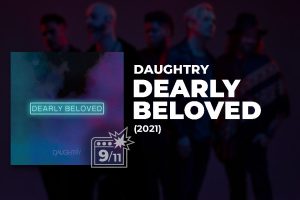
 Dearly Beloved is Daughtry’s best record in years: heavier guitars, modern synth atmosphere, huge choruses and renewed creative confidence.
 Reviews, Daughtry
 Daughtry’s Cage to Rattle (2018) trades crunch for polish, delivering strong atmospherics but too many weightless mid-tempo moments to stick.

Leave a Reply to Daughtry – Cage To Rattle (2018) Review | These Go To Eleven Cancel reply