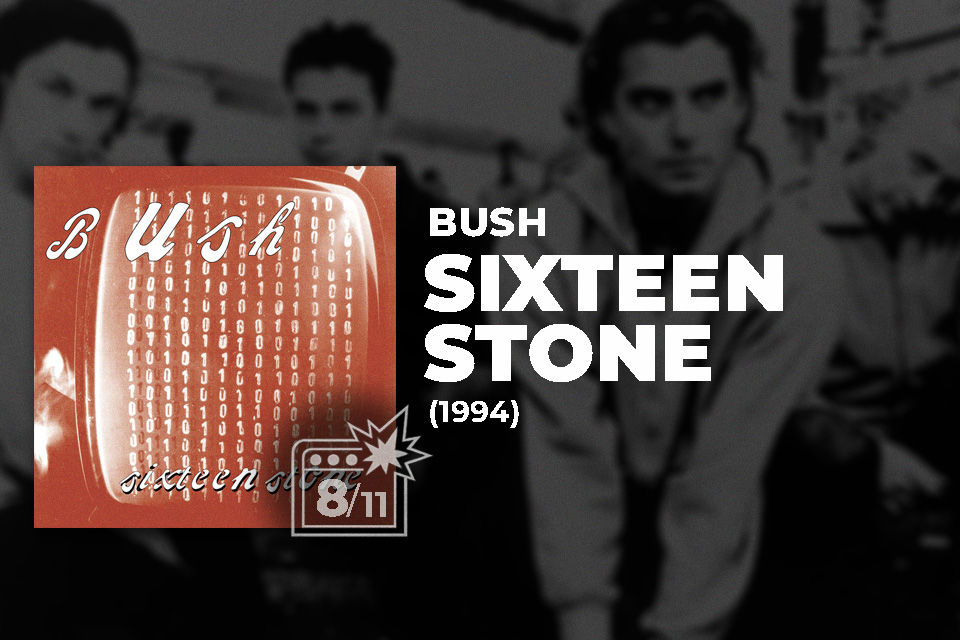
In summary:
A polarising debut with a monster singles run — flawed, but packed with mid-’90s alternative rock staples.
Sixteen Stone receives 8/11.
★ ★ ★ ★ ★ ★ ★ ★
Album details
Album Details
Release date: November 1st, 1994
Label: Interscope Records
Producer: Clive Langer and Alan Winstanley
Musicians:
- Gavin Rossdale (vocals, rhythm guitar)
- Nigel Pulsford (lead guitar)
- Dave Parsons (bass)
- Robin Goodridge (drums)
Singles:
- Everything Zen
- Little Things
- Comedown
- Glycerine
- Machinehead
Chart performance:
- #4 US Billboard 200
- #42 UK Album Chart
- #6 UK Rock And Metal Album Chart
Total sales: 6,800,000
Certification: 6x Platinum
Score: ★ ★ ★ ★ ★ ★ ★ ★
Bush – Sixteen Stone (1994) Review
Few debut albums split Britain and America quite like Sixteen Stone.
In the UK, Bush were dismissed early as “cheap Nirvana” opportunists — too glossy, too good-looking, too late to the grunge party. In the US, however, none of that mattered. The songs landed, the singles kept coming, and Bush achieved stadium-level fame off the back of a record that didn’t ask for any of the controversy it created.
Three decades on, the most telling thing is how well it has survived.
Because despite the fact you can hear the grunge era’s hallmarks all over it — excess distortion, quiet-loud dynamics — the album still bites, and still demands to be played at maximum volume.

The Transatlantic Problem
The backlash in Bush’s homeland didn’t come out of nowhere.
Sixteen Stone arrived in the long shadow of Seattle, with the “authenticity police” still patrolling the wreckage of early-’90s grunge, and comparisons to Nirvana becoming a lazy shortcut in the press.
America, meanwhile, treated the record as what it actually was: a mainstream alternative rock album with a deep singles bench. It climbed to No. 4 on the Billboard 200, and it didn’t do it in a one-week burst — it did it via momentum.
This is the key point: whatever debates raged about image or influence, Sixteen Stone triumphed because it delivered songs that radio could return to repeatedly without scraping the barrel.
"There's no sex in your violence."

EVERYTHING ZEN

The Sound That Sold It
The album’s formula is simple and effective: distorted guitars, restrained verses, and choruses that blow the roof off.
Langer and Winstanley’s production is tidy enough for US airplay, but it still leaves plenty of grit in the frame — especially when the band commit to that “tight verse / explosive chorus” design.
The final result is a record that can sound smooth and scrappy within the same track, which is a big reason it crossed over so easily.
If you want the cleanest example of the album’s appeal, it’s right at the front.

A Singles Run Most Debuts Would Kill For
Everything Zen opens the album with a snarl and a hook — the moment you realise this isn’t going to be a polite introduction.
From there, the record begins stacking radio staples with almost unfair ease.
Comedown is the slow-burn classic that became a defining mid-’90s alternative single, all tension and release. Machinehead is pure propulsion — one of those riffs that feels like it has always existed. And Glycerine is the emotional centre: stripped back, bruised, and still the song most likely to make even sceptics pause and admit that frontman Gavin Rossdale had the goods.
This run of undeniable hits is the reason Sixteen Stone’s reputation outlived its backlash.

No Beating About The Bush
The best deep cuts are the ones where Bush sound like they’re bristling at the criticism in real time.
Monkey and Testosterone are blunt, heavy swings — less subtle, more confrontational — and they play like a band reacting to the “manufactured” tag by turning the volume up and daring you to flinch.
Rossdale’s writing style also helps the album age better than it should. He favours vivid phrases and sideways imagery over neat, time-stamped storytelling — a choice he’s said was partly about avoiding songs being trapped in a specific moment.
That approach doesn’t make every lyric land, but it does make the album feel less “1994” and more like a mood you can still step into.
"I'd die in your arms if you were dead too."

LITTLE THINGS

Struggling To Swim
Sixteen Stone isn’t a flawless debut, and it doesn’t need to be treated as one.
The momentum-draining duo of Bomb and Swim would have been better left on the cutting room floor, but instead they are given centre stage; arriving far too early in the playlist, and undoing a sizeable chunk of Everything Zen’s impactful start.
They are joined by the lacklustre Body — a song that posseses the loose shape of a grunge track minus the urgency that makes the template work.
Sixteen Stone also features a few numbers that are almost great, but miss the mark. The slow-building Alien is a prime example: the chorus crash-lands like a rocket re-entering the atmosphere, but the rest of the track doesn’t build enough tension to earn the payoff — unfortunately, you’re left hearing a brilliant hook trapped inside a composition that needed another writing pass.

Legacy
The irony of the “too manufactured” criticism is that the LP’s staying power ended up answering it.
Sixteen Stone is now a certified multi-platinum record in the US: initially certified 6× Platinum by the RIAA in the late ’90s, and then recognised at 7× Platinum levels in the 2000s. It has surpassed six million US sales, and remains Bush’s signature release in a career spanning more than thirty years.
The album was notably less dominant in the UK, although it still earned official chart and silver certification recognition.
So yes: their homeland’s scepticism is part of the story — but considering how well the record has stood the test of time, it appears that America’s read on the situation was correct.

Bush – Sixteen Stone
Sixteen Stone is a debut built on contrast.
It’s about polish versus bite, restraint versus release, a credibility debate versus undeniable singles.
It’s not a track-for-track classic, and the weaker cuts prove that. But when it works, it works exceptionally well — the singles run is gigantic, the best deep cuts still hit with real force, and the album’s sound has held up a lot better than many of their supposed “more authentic” contemporaries.
These Go To Eleven Reworked Tracklist
These Go To Eleven Reworked Tracklist
Sixteen Stone doesn’t need reinvention — it needs pacing.
This reworked tracklist keeps the big singles in a run that sustains momentum, while trimming the early-track lull, re-centering the spotlight on the sharp, hook-led version of Bush that America fell for.
Here’s how to experience Bush: Sixteen Stone (1994) for maximum impact:
- Everything Zen (4:38)
- Comedown (5:27) ★
- Little Things (4:24)
- Monkey (4:01)
- Glycerine (4:27) ★
- Machinehead (4:16) ★
- Testosterone (4:20)
- Body (5:43)
- X-Girlfriend (0:45)
- Alien (6:34)
★ Standout track
– Excluded tracks: Swim (4:56), Bomb (3:23)
In summary:
A polarising debut with a monster singles run — flawed, but packed with mid-’90s alternative rock staples.
Sixteen Stone receives 8/11.
★ ★ ★ ★ ★ ★ ★ ★
>> Sixteen Stone (1994) is part of our Bush series.
Related Posts
 Reviews, Bush
 Bush chase credibility with a harsher, moodier sound—effective at times, but less immediate than the debut.
 Reviews, Bush
 Bush hit their stride on a thrilling third album, while confirming that it is indeed “all over” for orangutans.
 Reviews, Bush
 Bush deliver the album of their career, but nobody was listening.

Leave a Reply to Bush – Golden State (2001) Review | These Go To Eleven Cancel reply