These Go To Eleven Says:
A polarising debut with a monster singles run — flawed, but packed with mid-’90s alternative rock staples.
★ ★ ★ ★ ★ ★ ★ ★
STANDOUTS Machinehead · Glycerine · Comedown
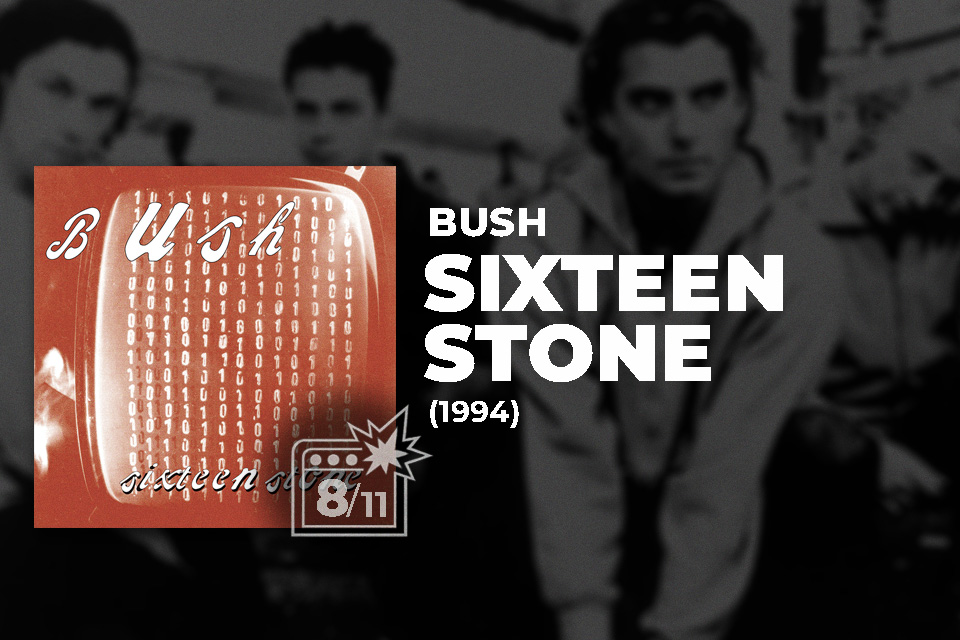
8/11
Strong
Album details & credits
- Title
- Sixteen Stone
- Artist
- Bush
- Released
- November 1, 1994
- Label
- Trauma/Interscope Records
- Produced by
- Cliver Langer & Alan Winstanley
- Key personnel
- Gavin Rossdale (vocals and rhythm guitar) · Nigel Pulsford (lead guitar) · Dave Parsons (bass) · Robin Goodridge (drums)
- Singles
- Everything Zen · Little Things · Comedown · Glycerine · Machinehead
- Chart performance
- No.4 on Billboard 200 Chart · No.42 on UK Albums Chart · No.6 on UK Rock & Metal Albums Chart
- Total sales
- 6,800,000
- Certification
- 7x platinum
- Score
- ★ ★ ★ ★ ★ ★ ★ ★
Bush – Sixteen Stone (1994) Review
Few debut albums split Britain and America quite like Sixteen Stone.
In Britain, Bush were dogged by accusations of Nirvana imitation: too glossy, too good-looking and too late to the grunge party. Meanwhile, American audiences proved considerably more welcoming — the hit singles kept coming, the album sold millions, and a group struggling for recognition at home suddenly became major stars in a foreign land.
Three decades on, the music offers plenty worth discussing beyond who sounded like whom.
Sixteen Stone contains a formidable collection of singles, a guitar partnership more interesting than its reputation suggests, and several reminders that writing a magnificent chorus does not automatically translate to having a magnificent song.

The Transatlantic Problem
The Nirvana comparisons were hardly plucked from thin air.
Rossdale’s abrasive delivery, the distorted wall of guitars and the familiar switch from subdued verses to erupting choruses placed Bush within an unmistakable musical lineage. Unfortunately, those similarities became an easy way for critics to dismiss the band before considering the quality of the material on show.
This wasn’t a case of the UK music press sneering while America wholly lapped it up — in fact, Bush received a large dollop of hostile media coverage within the US, even as their fanbase began to explode.
The commercial divide was clear, though: No.4 on the Billboard 200, and No.42 on the UK Albums Chart.
Record sales cannot settle an argument about originality, but neither does an obvious influence cancel out good songwriting. That’s an important distinction to make on Sixteen Stone, because despite the media’s obsessive arguing over whether the band’s grunge styling was pure or manufactured, the album ultimately triumphed on the back of one of the strongest singles runs of the decade.

The Sound That Sold It
Lead single Everything Zen makes an excellent opening argument.
Its chunky rhythm guitar gives Nigel Pulsford’s sliding, needling axe something solid to scrape against, establishing a tension that runs through the better songs here — Rossdale supplies the broad strokes, Pulsford introduces the awkward angles.
That partnership deserves more attention than it often receives.
Rossdale has since described his own guitar playing as instinctive and Pulsford’s as far more meticulous, crediting him with finding obscure notes that complemented his jagged voice. His lead guitar frequently behaves like a second, less agreeable singer, interrupting and answering rather than merely thickening the chords.
"There's no sex in your violence."

Everything Zen
Producers Clive Langer and Alan Winstanley have since recalled deliberately keeping the arrangements simple and overdubs limited, and this goes a long way to explaining why the record can sound both accessible and raw: the individual performances remain exposed, including the friction between the two guitars.
Rossdale is equally important to this balance. His blurred, fragmented lyrics pull the listener in before exploding to life via heavy choruses that somewhow retain the delicate feeling of unease that runs through the centre of the record.
Everything Zen is a prime example of this.
The track was penned in frustration as Rossdale’s struggled with his stalling music career, and describes the jealousy he felt upon hearing idol David Bowie heap praise on “bland” alt-rock outfit Suede.
Its lyrics remain deliberately abstract, yet a turbulent vocal delivery does a wonderful job of capturing the frontman’s bitter resentment. His repeated phrasing gradually grows in both agitation and desperation as the tension builds behind him — the song’s title seemingly promising a peaceful state of mind that its vengeful performance is spectacularly incapable of delivering.
Later, the crunching Little Things manages to push the same approach even further. Its clipped guitar figure and restrained verse leave plenty of room for Rossdale’s tortured voice to roam, before the chorus opens up into a ragged shout as Pulsford’s abrasive guitar scrapes around it.
Both songs may follow the established grunge template of the time, but the hooks are undeniably strong.

A Singles Run Most Debuts Would Kill For
By the time Little Things arrives, Sixteen Stone has already produced two formidable singles.
Remarkably, the best are still to come.
Comedown takes the opposite approach to the explosive quiet-loud shifts surrounding it. Dave Parsons’ circular bassline provides the song with an immediate physical pull, establishing a groove strong enough to carry the quieter passages with a simple yet instantly memorable riff.
Rossdale has since traced its inspiration back to the Billy Cobham bass figure sampled on Massive Attack’s iconic Safe From Harm — a revealing musical connection for a band so frequently discussed as if their influences started with Bleach and ended with In Utero.
The frontman’s drawn-out vocals seem to grate against the driving rhythm section, providing Comedown with a peculiar mixture of lashing out and crying for help simultaneously.
By the time the track’s chorus finally arrives, it feels truly enormous.
It’s quickly followed by the anthemic Machinehead, which dispenses with patience altogether.
Built around a bright, ascending hook that went on to become of the 90s’ defining guitar riffs, it cuts across power chords as if Nigel Pulsford had found a way to inject his Fender Stratocaster with pure adrenaline, as Rossdale punctuates the track with a muttered “breathe in, breathe out” lyric.
There’s no denying that the quality of the deeper cuts occasionally sinks, but this is an exceptional run of singles — and perhaps the reason why Sixteen Stone was able to outlive the backlash it initially received.
"I'd die in your arms, if you were dead too."

Little Things
Could’ve Been Easier On You
The album’s undoubted highlight is Glycerine.
Stripped down to just a bruised vocal, distorted guitar and eventual strings, it sounds almost naked beside the thunderous anthems that sit alongside it in the latter half of the album.
Yet it succeeds emphatically.
Kurt Cobain comparisons aside, Gavin Rossdale’s earnest vulnerability and obvious songwriting ability are laid bare here. Without the usual wall of guitars to lean on, the song is forced to live or die on the strength of its melody alone — and it does.
Glycerine would eventually cement itself as one of Bush’s definitive musical statements in a career spanning 30+ years. It was helped by heavy MTV exposure throughout the mid-to-late ’90s, but its reputation rests on something far simpler: it proved beyond all doubt that Rossdale was the real deal, and that he could write a genuinely affecting song without the need for studio trickery or sheer volume.

No Beating About The Bush
Beyond the singles, Monkey and Testosterone supply some welcome abrasion.
Monkey has a more fidgety relationship with its rhythm, its twitchy guitar hook preventing it from settling into a predictable stomp. Testosterone is more bluntly physical, with a swagger that suits Rossdale’s exaggerated delivery.
Both give the album a rougher character than its most familiar radio moments might suggest.
They also expose an important part of Bush’s appeal: Rossdale possesses a unique ability to make a phrase compelling before its meaning is revealed. This is a deliberate move, with the frontman later explaining that he prefers writing vivid, fragemented lyrics (“Got a machine head, it’s better than the rest”) in a bid to prevent his music from sounding locked to a certain era.
This approach doesn’t help every lyric land, but succeeds in making the album feel less “1994” and more like a mood you can tap in and out of at will.
Struggling To Swim
Sixteen Stone isn’t a flawless debut, and it doesn’t need to be treated as one.
The momentum-draining duo of Bomb and Swim would have been better left on the cutting room floor, but instead they’re given centre stage; arriving far too early in the playlist, and undoing a sizeable chunk of Everything Zen’s impactful start.
Swim manages to stretch its unwelcome murk across nearly five minutes without ever finding a melody strong enough to justify it, while Bomb’s aimless guitar attack feels like a complete waste of time.
Elsewhere, the slow-building Alien proves to be a far more frustrating listen.
Nigel Pulsford’s guitar work ensures that the chorus crash-lands like a spaceship re-entering the atmosphere, but it is ultimately let down by a weak surrounding musical arrangement that never generates enough tension to deserve this massive payoff. The track’s extended runtime also makes the distance between each arrival feel like a genuine slog — a brilliant hook, trapped forever inside a composition that needed another writing pass.
The Legacy Of Sixteen Stone
It’s somewhat ironic that this album’s lasting legacy is its staying power.
Interestingly, it has aged remarkably well in comparison to mid-90s offerings from some of their so-called “more authentic” contemporaries, and this is largely down to the minimalistic production and Rossdale’s keen ear for melody.
Snarky critics were quick to dismiss Bush as “a calculated attempt to cash-in on the grunge trend”, and they never convinced their home nation to support them, but Sixteen Stone still became one of the biggest-selling rock albums of the 1990s, shifting a whopping six million copies in the US alone, and going 7x platinum in the process.

Bush – Sixteen Stone
Sixteen Stone established the songs against which much of Bush’s subsequent career would be measured.
That is an enormous achievement for a debut, although it has sometimes obscured the improvements that followed. 1998’s The Science of Things would introduce a broader musical palette to the band’s sound, while Golden State would perhaps make a stronger case for Bush across an entire album.
Yet, as uneven as it is, no future Bush record would match the sheer impact of this 1994 debut.
It has aged remarkably well, and is fully deserving of a retrospective thumbs up to displace the unfair treatment it received upon initial release.
FINAL VERDICT:
A polarising debut with a monster singles run — flawed, but packed with mid-’90s alternative rock staples.
★ ★ ★ ★ ★ ★ ★ ★
8/11
Strong
See Our Reworked Tracklist
These Go To Eleven
Reworked Tracklist
Our reworked tracklist puts the big singles into a momentum-filled run, while trimming the album’s early lull, reshaping the record into the hook-driven version of Bush that America fell for.
Here’s how we recommend listening to Bush: Sixteen Stone for maximum impact:
- Everything Zen (4:38)
- Comedown (5:27) ★
- Little Things (4:24)
- Monkey (4:01)
- Glycerine (4:27) ★
- Machinehead (4:16) ★
- Testosterone (4:20)
- Body (5:43)
- X-Girlfriend (0:45)
- Alien (6:34)
★ Standout track
– Excluded tracks: Swim (4:56), Bomb (3:23)
STANDOUTS Machinehead · Glycerine · Comedown
MORE READING Sixteen Stone (1994) is part of our Bush album review series.
Further reading
Continue the Bush story.

Bush deliver the album of their career, but nobody was listening.

Bush hit their stride on a thrilling third album, while confirming that it is indeed “all over” for orangutans.

Bush chase credibility with a harsher, moodier sound—effective at times, but less immediate than the debut.

Explore the full Bush discography guide
Bush’s catalogue is one of rock’s more fascinating arcs: a huge grunge-era breakthrough, a backlash-fuelled search for credibility, a polished late-’90s peak, and an unexpectedly strong second incarnation.