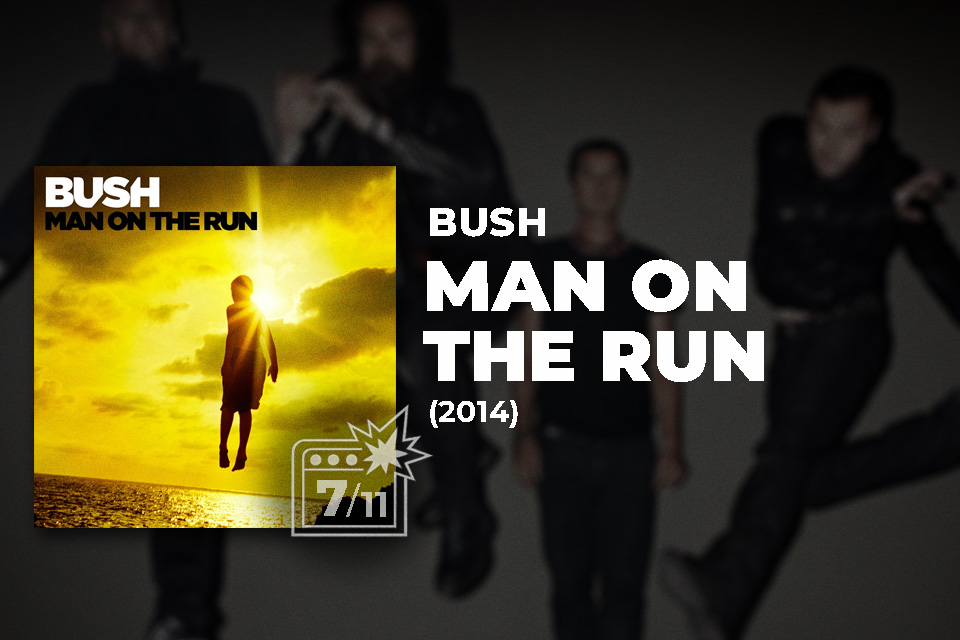
These Go To Eleven Says:
A series of well-crafted deep cuts make for an interesting EDM-inspired Bush record.
★ ★ ★ ★ ★ ★ ★
STANDOUTS The Only Way Out · Broken In Paradise · This House Is On Fire
7/11
Solid
Album details & credits
- Title
- Man On The Run
- Artist
- Bush
- Released
- October 21, 2014
- Label
- Zuma Rock Records
- Produced by
- Nick Raskulinecz & Jay Baumgardner
- Key personnel
- Gavin Rossdale (vocals and rhythm guitar) · Chris Traynor (lead guitar) · Corey Britz (bass) · Robin Goodridge (drums)
- Singles
- The Only Way Out · Man On The Run · Loneliness Is A Killer
- Chart performance
- No.33 on Billboard 200 Chart · No.8 on Billboard Rock Chart · No.104 on UK Albums Chart · No.28 on UK Rock & Metal Albums Chart
- Total sales
- 11,000
- Certification
- n/a
- Score
- ★ ★ ★ ★ ★ ★ ★
Bush – Man On The Run (2014) Review
Three years since returning from the wilderness, UK rockers Bush push their sound into new realms with Man On The Run.
Their experimental sixth album incorporates elements of grunge, rock, pop and — yes — EDM.
Surprisingly, this mish-mash works better than anyone had a right to expect.
The electronic textures frame Gavin Rossdale’s trademark abstract wordplay to good effect, and axeman Chris Traynor delivers another stellar performance with a further demonstration of the slick, understated guitar work that made their 2011 comeback The Sea Of Memories such a standout.

A Perfect Paradox
Lead single The Only Way Out is an interesting affair.
Tight, glossy, and effortlessly catchy, the song successfully captures all the best elements of modern Bush.
Interestingly, Rossdale has since explained that this arrangement began life as an overly complex progressive rock song, only to drive him up the wall with frustration before being rewritten in its current, ultra-simple format.
It’s a good job he shifted gears, because the final version is fantastic.
It’s an accessible entry point into the album, carrying many of the hallmarks of 2011’s The Sea Of Memories. In doing so, it operates neatly as a bridge between that record’s mainstream sensibilities and the more experimental material lurking in Man On The Run’s deeper waters.
In a paradox so abstract it could be a Gavin Rossdale lyric itself, it turns out The Only Way Out is the easiest way in.
"Follow me down to the water, through the tripwires in your head."

The Only Way Out

A Series Of Systems
Man On The Run sounds like no Bush album before it.
Sure, the band had experimented with keyboards, drum loops, and computer programming as far back as 1999’s The Science Of Things, and they had even released a compilation of full-blown drum and bass remixes before that. But they had never delivered anything quite like this.
That’s because Man On The Run is essentially two competing albums trapped in one body.
On one side of the coin, Gavin Rossdale wanted to capture the raw energy of their recent travels:
“The Sea Of Memories tour reminded me how much I’d missed being in a band. I wanted to celebrate that on this record, with a bunch of songs that’ll be great to play live.”
– Gavin Rossdale
Yet, this traditional rock mentality was directly juxtaposed by his sudden fascination with contemporary electronic dance music:
“I’m fascinated by the way people disappear into EDM. It’s those moments in Ibiza where 10,000 people put their hands up at once and just get lost in the music, you know? Obviously we don’t want to stray too far away from what we do, but this was in the back of my mind when I was writing the songs for this record.”
– Gavin Rossdale
This antagonistic combination of traditional and futuristic gives Man On The Run its unusual sound.
On the one hand, each track was written with the band’s live setlist in mind, then recorded using pawnshop guitars and old-school amplifiers in a bid to capture the essence of a garage band rediscovering the joy of life on the road. On the other, producer Jay Baumgardner was encouraged to introduce as many electronic textures into the mix as possible.
This bizarre clash of styles creates an audible push-pull dynamic, leaving the listener with a record that feels propelled forward only by how hard it pulls to the left and right.
One could argue that this is merely the latest example of Rossdale’s ability to self-sabotage — unnecessarily overcomplicating matters by adding edgy, contemporary elements to Bush’s sonic palette rather than leaning into his obvious talent for penning radio-friendly guitar hooks. At times, it can be fascinating to hear him deny his gift, even if the end result is never quite compelling.
Here Comes The Warm Machine
The knock-on effect of the EDM influence is that it alters the very architecture of the music.
Gavin Rossdale’s classic 90s blueprint — subdued, monotone verses giving way to big, aggressive choruses — has been replaced by a far more melodic, uplifting delivery.
The stunning Broken In Paradise is the clearest example of this shift.
This gloriously warm ballad explores the reality that money and status rarely guarantee internal happiness, driving its point home with a kaleidoscopic rhythm section that’s stapled together by one of Rossdale’s best vocal performances to date.
It’s a strategy the band successfully deploy across the equally satisfying Surrender, Let Yourself Go and Eye Of The Storm. Together, these tracks trap the spirit of past hits like Alien and Inflatable inside a glossy, modern capsule — a look that suits the 2014 iteration of Bush remarkably well.
"Inside of you with all your lies, nettles and vines."

The Gift
Deep Cuts Galore
While Man On The Run may lack obvious hit singles, it more than makes up for it with a plethora of impressive deep cuts.
Few would expect anything here to rival the band’s world-beating run of singles from Sixteen Stone. However, much like 2001’s superb Golden State, the collective sum of all the parts makes for an unexpectedly consistent listen.
Highlights include the instantly singable This House Is On Fire, the rip-roaring chorus of the Soundgarden-inspired album opener Just Like My Other Sins, and the erratic, stop-start time signatures of Bodies In Motion — a track initially intended to serve as the record’s title track.
Speaking of the actual title track, Man On The Run is a serviceable mid-tempo rocker. It will ultimately be remembered less for its hooks and more for inspiring the album’s overall aesthetic, which Rossdale famously described as “garage electronics”. However, the core elements of this track would eventually be executed far more effectively on 2017’s Alien Language.
Elsewhere, bonus track Speeding Through The Bright Lights glides along beautifully like a forgotten outtake from the Golden State era, leaving the listener wondering why on Earth it was deemed unworthy of making the standard album’s final cut.
“The overall feel of this record is something I like to call ‘garage electronics’ (laughs). I’ve always wondered what might happen if heavy guitars, big drum programming, and all these electronic soundscapes were thrown in a washing machine together.”
– Gavin Rossdale
It’s The Little Things That Kill
Yet, despite clocking up frequent flyer miles, Man On The Run never truly soars.
This is largely because its competing musical directions occasionally cause the material to stumble over its own feet. On previous efforts, a crunching rocker like Loneliness Is A Killer would pack the kind of visceral punch that made your speakers shake. Here, trapped inside a sanitised, “adult contemporary” setting, it never quite lives up to its early promise.
The same can be said for The Gift and even the otherwise enjoyable Bodies In Motion — both of which could have benefitted enormously from the jagged, rough edges that defined the band’s early sound.
Furthermore, while the record features several instances of clever wordplay from the always abstract frontman, the return of an old vocal tic frustrates the most. Oddly, Rossdale frequently mentions the word “systems” — a lyrical crutch he leaned on just as heavily some 18 years earlier throughout Razorblade Suitcase.
"My mind spins like helicopter blades."

Man On The Run
Commercial Performance
Commercially, Man On The Run was a step back from its predecessor.
It reached a lower overall position on several US charts, and lead single The Only Way Out failed to replicate the massive rock radio airplay of The Sound Of Winter.
However, it wasn’t a total disaster.
After all, Bush did still achieve a top 40 album in America, and the aforementioned single was able to notch an impressive 20 weeks on Billboard’s Alternative Airplay chart.
Bush – Man On The Run
Ultimately, Man On The Run’s self-imposed identity crisis is what gives the album its charm.
This back-to-basics rock record, masquerading as an EDM experiment, never quite produces anything capable of rivalling the band’s very best work. However, it also avoids dropping off a cliff in terms of overall quality — a baseline consistency that couldn’t always be guaranteed on previous Bush albums.
Would it have been interesting to see Gavin Rossdale drill deeper into the pristine, stadium-ready appeal Bob Rock brought to The Sea Of Memories? Absolutely. Would long-time fans have welcomed a straightforward return to the jagged, visceral volume of Sixteen Stone? No doubt.
But considerable credit must be given to Bush for retaining their sense of musical ambition. Rather than comfortably resting on past laurels, they chose to pursue a new horizon.
With that adventurous spirit in mind, Man On The Run is a qualified success.
FINAL VERDICT:
A series of well-crafted deep cuts make for an interesting EDM-inspired Bush record.
★ ★ ★ ★ ★ ★ ★
7/11
Solid
See Our Reworked Tracklist
These Go To Eleven
Reworked Tracklist
Our alternative running order sets the record up for a stronger hit; leading with The Only Way Out, then strategically placing the best of the rest where they can land with maximum impact.
Here’s how we recommend listening to Bush: Man On The Run (2014) for best results:
- The Only Way Out (3:22) ★
- Bodies In Motion (4:54)
- Man On The Run (4:23)
- Broken In Paradise (4:18) ★
- The Gift (4:49)
- Speeding Through The Bright Lights (5:09) ^
- Surrender (4:56)
- Just Like My Other Sins (3:23)
- This House Is On Fire (5:15) ★
- The Golden Age (5:44) ^
- Loneliness Is A Killer (5:17)
- Dangerous Love (4:51)
- Let Yourself Go (4:47) ^
- Eye Of The Storm (5:13)
★ Standout track
^ Featured on Man On The Run: Deluxe Edition (2014)
STANDOUTS The Only Way Out · Broken In Paradise · This House Is On Fire
MORE READING Man On The Run (2014) is part of our Bush album review series.
Further reading
Continue the Bush story.

Bush return in strong form on The Sea of Memories, blending modern production and huge rock-radio choruses.

Bush deliver the album of their career, but nobody was listening.

Bush hit their stride on a thrilling third album, while confirming that it is indeed “all over” for orangutans.

Explore the full Bush discography guide
Bush’s catalogue is one of rock’s more fascinating arcs: a huge grunge-era breakthrough, a backlash-fuelled search for credibility, a polished late-’90s peak, and an unexpectedly strong second incarnation.