The Story Of… Guns N’ Roses’ Comeback At Rock In Rio 2001
Guns N’ Roses entered the new millennium as a myth.
The original line-up had long since collapsed, Axl Rose had vanished from public view, and the replacement band he’d been assembling behind closed doors existed more as rumour than reality.
So naturally, he chose to return by headlining a festival in front of roughly 200,000 people.
Subtle, this was not.
Welcome to the world of Nu-GNR. Welcome to Rock In Rio III.
Gone Too Long
Seven years is a long time to be away.
In the pre-social media era, it was an eternity.
Today, musicians can step away from the scene while retaining a certain level of public image through interviews, Instagram clips, and the endless churn of online attention — indeed, both Beyonce and Janet Jackson recently enjoyed seven year gaps between records, while neither faded from the public eye.
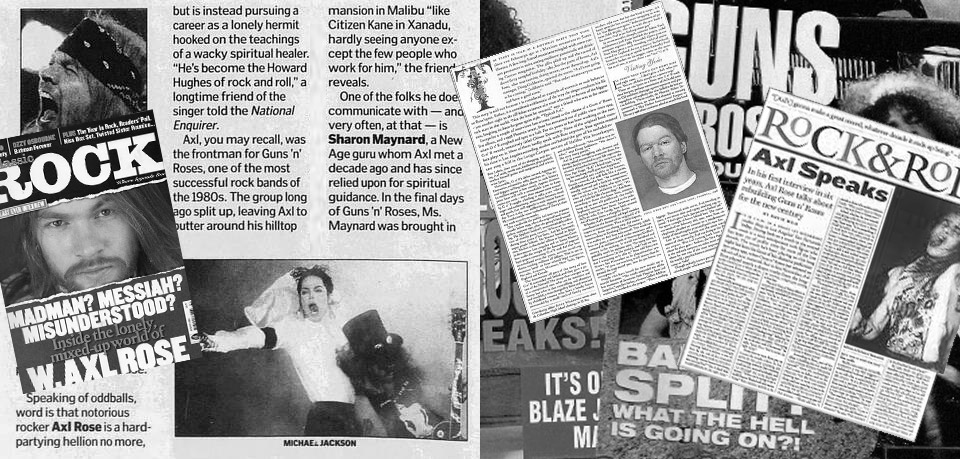
But when Axl Rose decided to go home in 1994, he simply vanished.
The disappearance of the world’s most recognisable rockstar left the media trying to fill a headline vacuum, and they began resorting to Michael Jackson-like sensationalism about Rose’s reclusive lifestyle, which only served to grow the mythology around him even more.
Was he really sending photos of potential recruits to an Arizona life coach so that she could review their auras and judge whether they would one day betray him? Had he gone bald? Had he become obese? Had he lost his mind? Nobody seemed to know, and the absence of real information only fed the frenzy.
Furthermore, time was having an effect the audience too. A generation of GN’R fans had grown up in the years since Use Your Illusion, and with no fresh material to challenge it, the old material had begun hardening into the stuff of legend. Songs that once sat comfortably in the “very good” category (e.g. Breakdown, Pretty Tied Up, and Civil War) were now being referenced as untouchable classics, which only heaped further pressure on Rose — not only to prove he could still perform them live, but also to deliver new songs that could stack up against an unreasonably high bar.
But first, he had to re-enter a storyline that had spent seven years getting bigger without him…

You Know I Know Better
By January 2001, anticipation around the so-called “Nu-Guns” had reached fever pitch.
The symbolism was irresistible: almost a decade after the original band’s appearance at Rock In Rio II, Axl Rose was back in Brazil with an entirely rebuilt line-up and a point to prove.
Even among a bill stacked with major names, the attention was fixed overwhelmingly on him. Current gen superstars such as Britney Spears, Papa Roach, and a recently reformed Iron Maiden were able to enjoy the freedom of Rio’s beautiful beaches without pressure from the media, who stayed rooted to the resort’s main hotel in the hope of capturing a shot of the elusive Rose.
The excitement, though, came wrapped in dread.
Rose’s reputation by that point was so combustible that plenty of people still didn’t believe he would actually turn up. That was the risk with Axl: until he was physically onstage, nothing felt real. And given the false starts, the self-imposed exile, and the immense pressure to deliever, this comeback had all the ingredients of a glorious disaster.
But despite all of that, over a third of the gargantuan crowd had come sporting GN’R-related merchandise in the hopes that this really would be the beginning of a new era.

I Don’t Need Your Civil War
Then he arrived in Rio — and the first surprise landed before a note had been played.
Because instead of the volatile, suspicious Axl of old, the media encountered a man who seemed… calm.
He smiled for photographs. He walked the beach. He looked healthy. More than that, he looked oddly comfortable inside the eye of the storm. The old danger hadn’t completely vanished, but it no longer seemed to own him in the same way — this wasn’t the feral ringmaster of the Use Your Illusion years, but someone quieter, more inward, and more in control of himself.
That unexpected behavioural curveball only served to give us more questions…
Had Axl finally changed his ways? Will this new attitude be reflected in the new music (if there is any)? Or, could it be that this is just an act for the cameras; an elaborate move perhaps designed to rub salt into the wounds of his ex-bandmates, by suggesting that they really were the problem, and that he had fully healed now that they were gone?
That’s the beauty of Guns N’ Roses — you never knew.
All of this, of course, did not mean he’d stopped being Axl Rose the rockstar.
The helicopter still touched down obscenely late. The band still took the scenic route to the stage. And the crowd still had to wait well beyond the scheduled start time before anything actually happened. Some habits, clearly, survive every spiritual awakening — especially in the Axlverse, where clocks have always seemed more like suggestions than rules.
The difference was that this time the audience didn’t care — they’d waited seven years already, another ninety minutes was nothing.

Out of the Wilderness, and Back Into the Jungle
The show was preceeded by a cartoon mocking “Uncle Axl” and his years of reclusion.
It was a clever touch. Self-aware, slightly absurd, and — more importantly — proof that the show was actually happening. Even then, you got the sense that part of the crowd was still waiting for the trick. They needed undeniable confirmation that this wasn’t about to collapse at the final hurdle.
The staccato riff of Welcome to the Jungle then began cutting its way through the Rio skyline.
And suddenly all doubt disappeared.
“Do you know where the fuck you are?”
Rose’s unmistakable scream had to do much more than just open the set. It needed to justify years of chaos, silence, rumour, and ridicule. And it did. Over half a decade of frustration and anger was captured inside one unrelenting twenty second howl.
It was a moment for the ages, and it sent the 200,000-strong Rio crowd over the top. Textbook.

Shotgun Blues
Then the lights came up, and the new band stood exposed.
Axl on vocals. Dizzy Reed still in place. Buckethead and Robin Finck sharing lead guitar duties. The problematic Paul Huge on rhythm guitar. Tommy Stinson on bass. Brain on drums.
On paper, it was bizarre. Onstage, it looked even stranger.
There was none of the effortless street-level cool that had defined the original Guns N’ Roses. This line-up looked assembled from several different dimensions: Buckethead’s surreal horror-show anonymity, Finck’s gothic futurism, Stinson’s punk disrepair, and Axl himself dressed in a style that felt both outrageous and oddly functional.
It was not classic GN’R. It was not designed to be. And for many fans, that was part of the problem.

Get in the Ring
The one thing the new band couldn’t be accused of was not being able to play.
Axl had previously given an interview to Rolling Stone where he promised that the new recruits could “play the shit out of” the old songs, and here they did exactly that.
Buckethead, in particular, was extraordinary.
To mainstream GN’R fans, he was still an unknown quantity. To guitar obsessives, he was already a monster. At Rio, those two realities collided. He ripped through Slash’s most famous parts with absurd ease, threw in extra flourishes for good measure, and somehow managed to look both ridiculous and unstoppable at the same time. He didn’t try to imitate the old band, so much as detonate it from within.
That same charge ran through the rest of the line-up. Finck was note perfect, Stinson brought real attitude, Brain’s drumming had force and flexibility, and Dizzy’s continued presence acted as the one visible thread connecting old Guns to new.
Their versatility must also be praised. GN’R were unlike other bands, in that they didn’t use a preset setlist. Instead, Rose preferred to shout the name of the song on stage. This only makes the performance of “Nu-GNR” even more impressive — it was already astonishing that they were playing a show of such magnitude after just six weeks of rehearsals, let alone that they’d been able to master the entire GN’R back-catalogue to a level which allowed them to play anything from it whenever, wherever.
Most importantly, Axl seemed energised by the new members’ presence.
He moved well. He looked engaged. He seemed genuinely happy to be there.
Aside from one flash of temper — the ejection of a fan wearing a “Slash Is GNR” shirt — he handled the audience with far more ease than many had expected, and even found room for one of the night’s most revealing bits of stage chatter when he admitted disappointment that former bandmates were not there, utilising Rio’s media platform to push the narrative that the old band collapsed as a result of his ex-bandmates’ agendas, rather than his own.
“I know that many of you are disappointed that some of the people who you came to know and love could not be here today. Regardless of what you’ve read, I can tell you that those same people worked very hard to try to stop me from being here too. Believe me, I’m as disappointed as you are that we couldn’t all find a way to get along.”
– Axl Rose
The Wheels Already Set In Motion
He may have defied the media’s expectations, this wasn’t a perfect performance from Rose.
There are moments where the voice wobbles. The old rasp appeared to be already thinning in places. Watching it back in retrospect, you can see the early hints of the vocal issues that would later become a far bigger story.
But in this moment, with this much emotion in the air, the audience gave him every inch of grace he needed.
And then came the line that changed the mood entirely:
“Here’s a couple of songs that’ll be on the next album.”
At that point, Chinese Democracy was less a record than a cryptid. People weren’t even sure it really existed — and yet here it was, suddenly made tangible for the very first time in front of 200,000 people.
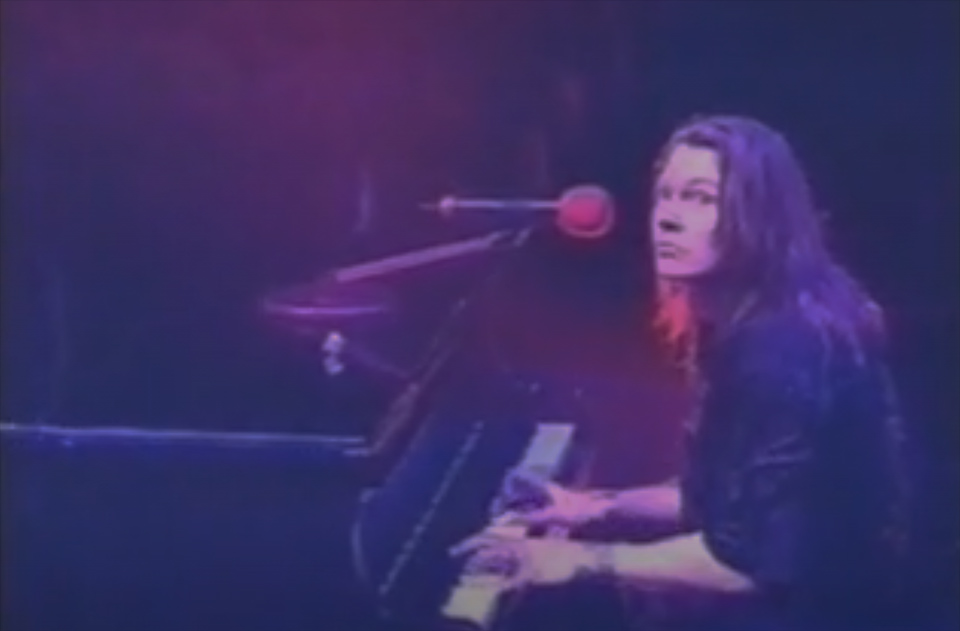
The title track sounded meaner and more direct than the studio version that would emerge years later. Elsewhere, the soaring piano ballad The Blues (later renamed Street of Dreams) showed a more melodic side. It also provided a couple of interesting asides — first when Rose teetered on the brink of a meltdown, yelling “Okay, never mind!” at the top of his voice to an unsuspecting audio technician who had inadvertently messed up his mic, and then an impressive demonstration of how locked-in the new band were, all spotting that Robin Finck’s impending guitar solo would be rendered inaudible by the tech problem, and skipping over that segment of the track in beautiful tandem motion without missing a beat.
Finally, a third new track called Madagascar arrived later, highlighted by a slow-burning guitar solo from Buckethead and a sense of scale that suggested Axl was not remotely interested in simply rebuilding Appetite For Destruction with different faces.
That was the promise and the problem in one — the new band could absolutely play the old songs, but Axl had not returned to become a heritage act.

Everything Was Roses When We Held On To The Guns
By the time Paradise City brought the night to a close, the verdict felt clear:
This had worked.
Not perfectly. Not effortlessly. But decisively.
The sheer arrogance of choosing Rock In Rio as the setting for such a high-stakes return suddenly looked less like recklessness and more like instinct. Axl Rose had spent years hidden away, rebuilding his band in private and inviting mockery with every month of silence. And then he walked back onstage at one of the world’s biggest rock shows and, against every reasonable expectation, pulled it off.
“About ten minutes into their set, it became clear that the new Guns N’ Roses is a rock ‘n’ roll event — the sort a lot of people, myself included, have been waiting for. The reigning rap-rock and nu-metal outfits of this era, such as Korn and Limp Bizkit, manage to get by on pure sonic wallop, but so-called Nu-GNR already play with a level of precision and passion that’s unlikely to be matched anytime soon, which is astounding when you consider that they’ve only had a month of rehearsals.”
– Kurt Loder, MTV
“For all the mystery and uncertainty surrounding him in recent years, it was like Axl Rose had never been away. Any worries he may have harboured about fans rejecting his brand new incarnation of Guns N’ Roses proved to be unfounded, with the overwhelming majority of the 200,000 in attendance delighted to see him back on stage.
Indeed, there was a particularly disarming moment for the notoriously strong-willed Rose as the crowd began chanting “Welcome back”, to which he could only smile and say “Now you’re embarassing me.” That may be so, but the most memorable aspect of this long-delayed return is that Rose never came close to embarassing himself nor the legacy of GN’R.”
– Steve Appleford, The Los Angeles Times
Yesterdays Got Nothing For Me
And that, of course, is what makes Rock In Rio 2001 so enthralling.
Because the door was wide open, but Axl refused to walk through it.
Straight-ahead hard rock was in desperate need of a saviour. The comeback had landed successfully. The new songs had intrigued people. The eclectic line-up had passed its first colossal test. It genuinely felt as though Rose had a clear path in front of him — one that could have delivered the kind of late-career resurgence enjoyed by older heroes like Aerosmith and Alice Cooper.
He just didn’t want that version of the future.
Rather than building upon nostalgia and commercial comfort, Rose wanted to create something bigger, stranger, and more personal. In his mind, Chinese Democracy wasn’t supposed to be a crowd-pleasing rock comeback. It was supposed to be the next mutation of Guns N’ Roses — just as Use Your Illusion had once moved away from Appetite for Destruction.
Artistically, that’s admirable.
Commercially, it was disastrous.
Because instead of capitalising on the goodwill he earned at Rock In Rio III, Axl disappeared for a two more years. By the time he re-emerged from the studio, the sparks generated in Brazil had long since dissipated. Momentum had been squandered. The grand reveal of Nu-GNR had not been followed by a campaign, but by another wall of silence and doubt which had pushed many fans to lose patience.
And that is the true legacy of Rock In Rio III.
Not just that Axl returned. Not just that the new band proved itself. But that for one dazzling, improbable night, Guns N’ Roses briefly looked like the most exciting unfinished story in rock music — and then wrote the next chapter in invisible ink.

Leave a Reply to Axl Rose's Failed Nu-GNR Project | Guns N' Roses Cancel reply