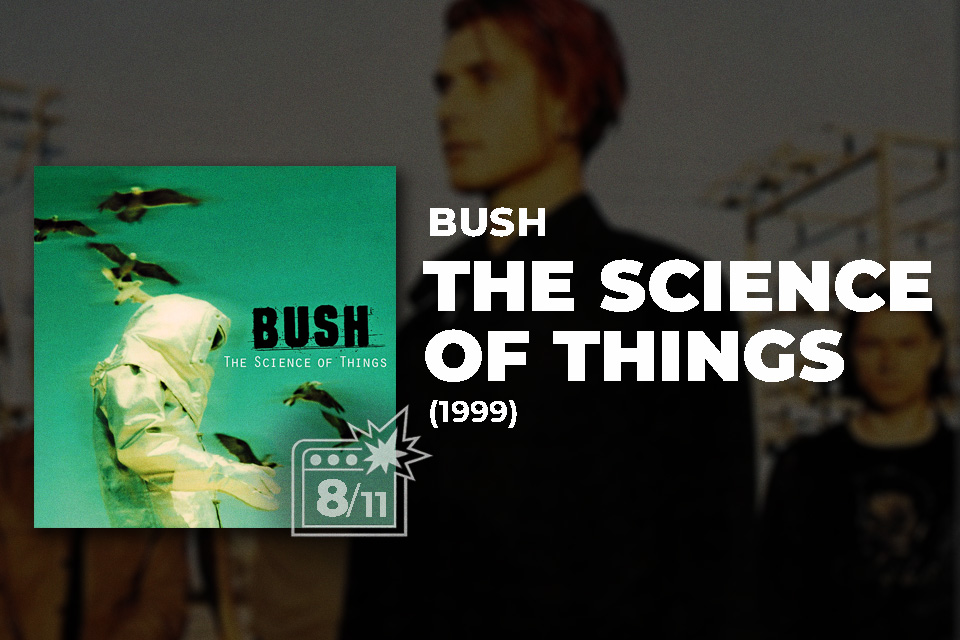
These Go To Eleven Says:
Bush trade baggy grunge for polished hard rock, delivering their most consistent album of the 90s.
★ ★ ★ ★ ★ ★ ★ ★
STANDOUTS The Chemicals Between Us · Warm Machine · Mindchanger
8/11
Strong
Album details & credits
- Title
- The Science Of Things
- Artist
- Bush
- Released
- October 26, 1999
- Label
- Trauma/Interscope Records
- Produced by
- Clive Langer & Alan Winstanley
- Key personnel
- Gavin Rossdale (vocals and rhythm guitar) · Nigel Pulsford (lead guitar) · Dave Parsons (bass) · Robin Goodridge (drums)
- Singles
- The Chemicals Between Us · Letting The Cables Sleep · Warm Machine
- Chart performance
- No.11 on Billboard 200 Chart · No.28 on UK Albums Chart · No.1 on UK Rock & Metal Albums Chart
- Total sales
- 1,250,000
- Certification
- Platinum
- Score
- ★ ★ ★ ★ ★ ★ ★ ★
Bush – The Science Of Things (1999) Review
You’ve got to hand it to Bush: they stuck with it.
After Sixteen Stone made them stars and Razorblade Suitcase sent them chasing credibility, third effort The Science of Things finds the band doing something smarter than either of those records.
For the first time in their career to date, Bush stop reacting — to critics, to trends, to those endless Nirvana comparisons — and start building around their own strengths.
The result is the fullest, most adventurous work of their career to date; an album less beholden to grunge orthodoxy, and more willing to thicken the mix with layers of electronics, loops and atmosphere without losing sight of the giant guitar hooks that made them such a force in the first place.

A Different Starting Point
Before recording began, Gavin Rossdale disappeared to Ireland for four months and came back with around 24 songs.
This wasn’t the usual collection of rough guitar ideas, either.
He had built near-complete demos on his own, even adding drums, bass, keyboards and layered vocals. The isolation of the trip also gave him his first real opportunity to process everything that had happened since Bush transformed from struggling musicians working the Londond scene to multi-million-selling rockstars.
This period of self-reflection shows.
Where its predecessor often mistook rough edges for authenticity, The Science Of Things arrives with a bold sense of self-confidence and a clear musical identity. Rossdale’s often overlooked bandmates deserve some credit for keeping his ambitions in check, too. The frontman later admitted that his original intention was to push the album’s electronic element even harder, but stood down when his colleagues argued that they should retain the outer shell of conventional rock songs.
This compromise proved useful, as the record bends the Bush formula as far as it’ll go without snapping.

Bush Remixing Bush
The electronic direction didn’t appear from nowhere.
Two years earlier, Deconstructed had handed Bush’s songs to a collection of remixers and allowed drum-and-bass, trip-hop and electronic production to pull familiar material apart. Drummer Robin Goodridge later described the approach to The Science Of Things as recording a rock album first, then spending several weeks adding elements of what they had learned from that experience to the new material.
“The electronic stuff was quite exciting. We recorded this as a rock record, then played with it in the studio for a few weeks — almost like Bush remixing Bush.
– Robin Goodridge
Unlike Deconstructed, the electronics serve a real purpose.
Loops and programming give Robin Goodridge’s live drums something to push against, while Nigel Pulsford benefits enormously from the additional space. His guitar work had always been strongest when it could scratch around Rossdale’s simpler rhythm parts; here, the electronic textures provide an entirely different set of surfaces to attack.
Opening track Warm Machine establishes this new balance immediately.
Its soaring riff leaves nobody wondering whether Bush have abandoned their rock roots, but the arrangement around it is considerably denser than anything from Sixteen Stone. Subtle electronic details move underneath the band without swallowing them, and the chorus sees Bush finally retain the directness they seemed so determined to self-sabotage on Razorblade Suitcase.
"Tread slowly for I know, there's a thousand miles to go — without blinking."

Warm Machine

I Want You To Remember
If Warm Machine introduces the new approach, The Chemicals Between Us proves it works.
Rossdale is said to have wanted a more contemporary sound that reflected the music surrounding him in London, explaining that he had no desire to spend the rest of his career making increasingly raucous guitar records simply because that was what people expected from him.
It’s an experiment that could’ve easily gone wrong.
Instead, The Chemicals Between Us remains unmistakably Bush; its programmed rhythm providing the track with a nervous momentum that a conventional drum pattern probably wouldn’t have been able to achieve, before Pulsford’s abrasive guitar cuts through the mix like a samurai sword.
It went on to become their fifth No.1 on Billboard’s Alternative chart, but the more important point here is musical rather than commercial: the band’s new ingredients take an already strong rocker and noticeably improve it.
Return of the Hooks
That also highlights one of The Science Of Things’ biggest improvements over its predecessor.
Rossdale stops treating his ability to write a huge chorus like something he ought to apologise for.
Prizefighter is heavy and cluttered, yet packed with melody. Dead Meat drives forward with considerably more purpose than much of Razorblade Suitcase, while Altered States successfully folds a series of experimental textures into an effective rock tune without losing sight of the goal.
Then there’s the gloriously overcooked The Disease Of The Dancing Cats; a track that sees distorted guitars and pummelling drums crash face-first into eachother, before spinkling extra helpings of that trademark Rossdale wordplay that sounds either ridiculous or brilliant depending on how much sleep you’ve had.
The expansive Spacetravel goes the other way, relying on atmosphere as opposed to volume. Gwen Stefani’s background vocal is an interesting feature; it is used with restraint, adding texture without turning the song into a celebrity duet.
It’s in these fine details where The Science Of Things manages to improve upon Bush’s first two albums. Both records suffered from a notable loss of momentum each time the band attempted to transition from heavy rock songs to quiter material, but here the UK rockers finally seem to have mastered the art of shifting gears.
"Your whiskey talks louder than most things I've read you've said."

The Disease Of The Dancing Cats

Where It Slips Up
Not all of the experiments work.
The stuttering English Fire never truly ignites — although Rossdale later named it as one of his favourites.
Elsewhere, the overlong 40 Miles From The Sun manages to build quite the absorbing atmosphere only to frustate by getting lost inside itself.
Nevertheless, this can be viewed as a major improvement upon Razorblade Suitcase, where baggy songs gathered in lengthy stretches and dragged down the whole listening experience. This time around, the surrounding material is more than strong enough to carry the weaker tracks — its floor is higher, even if its ceiling is arguably lower than the very best moments of Sixteen Stone.

Watching The Lights Go Down
Letting The Cables Sleep features Bush at their very best.
Stripping away their usual force has previously allowed Gavin Rossdale to shine on tracks like Glycerine and Bonedriven. Here, the addition of computer effects, piano and strings underpin one of his best performances to date.
The song addresses the emotional damage caused by carrying the weight of a painful secret alone, and it was written in response to one of his closest friends revealing that he’d been coping with a HIV-positive diagnosis — and all of the uncertainty that came with it — on his own due to the negative stigma surrounding the illness in the 1990s.
The sheer weight of this lyrical content foregoes the need for enormous guitar riffs.
Instead, the tension arrives by keeping everything restrained; the vocal, the arrangement, and the subject itself.
It provides one of the clearest examples of why The Science Of Things’ broader production takes the band’s core sound to new heights. On previous records, Bush would probably have recorded this as a straightforward ballad with a singular guitar sitting beneath Rossdale’s tortured vocal. That might’ve worked, but it wouldn’t have been anywhere near as effective as the version that you’re presented with here.
Ending on a High Note
The stellar second half of the record is where Bush really sell their new sound.
Perhap closing track Mindchanger says it best; layered guitars, looped drums, and Rossdale sounding both wounded and furious in equal measure.
On its way towards an impressive climax, the song produces one moment of genuine eardrum-piercing guitar distortion that comes when Nigel Pulsford’s axe appears to snap under the weight of Goodridge’s thunderous beat, which serves as a welcome reminder to listeners that Bush haven’t lost any of their trademark bite — they’ve simply learned how to control it.
It arrives after standout duo Altered States and Dead Meat have done a good job demonstrating how adept the UK rockers have become within the confines of grunge’s long-established quiet/load dynamic, and the aforementioned highlight Letting The Cables Sleep, which enjoyed a whopping 17 weeks on Billboard’s Alternative Airplay chart.

Bush – The Science Of Things
The Science Of Things is the first Bush album that feels fully realised from beginning to end.
With Gavin Rossdale’s guitar front and centre, the polished production suits the band perfectly. Furthermore, their experiments with electronic soundscapes provide a fresh sonic boom, finally shaking off those incessant Nirvana comparisons
While the record might lack the headline-grabbing singles of Sixteen Stone or the raw aggression of Razorblade Suitcase, its structural consistency allows it to succeed where its predecessors fell short.
Ultimately, it is the album where Bush stopped sounding like a band trapped inside someone else’s argument.
FINAL VERDICT:
Bush trade baggy grunge for polished hard rock, delivering their most consistent album of the 90s.
★ ★ ★ ★ ★ ★ ★ ★
8/11
Strong
See Our Reworked Tracklist
These Go To Eleven
Reworked Tracklist
This record doesn’t need to be rescued by a fresh mix, but it can be improved even further with superior pacing.
Here’s how we recommend listening to Bush: The Science Of Things (1999) for maximum impact:
- The Chemicals Between Us (3:37) ★
- The Disease Of The Dancing Cats (4:01)
- Warm Machine (4:26) ★
- Prizefighter (5:41)
- English Fire (3:31)
- Learning To Swim (4:59) ^
- Homebody (4:20) ^
- Jesus Online (3:44)
- 40 Miles From The Sun (3:39)
- Spacetravel (4:45)
- Altered States (4:10)
- Dead Meat (4:16)
- Letting The Cables Sleep (4:36)
- Mindchanger (4:48) ★
★ Standout track
^ Unreleased track
STANDOUTS The Chemicals Between Us · Warm Machine · Mindchanger
MORE READING The Science Of Things (1999) is part of our Bush discography.
Further reading
Continue the Bush story.
Bush deliver the album of their career, but nobody was listening.

Can Bush shake off those Nirvana comparisons with an album of electronica remixes? Err, no.

Bush chase credibility with a harsher, moodier sound—effective at times, but less immediate than the debut.

Explore the full Bush discography guide
Bush’s catalogue is one of rock’s more fascinating arcs: a huge grunge-era breakthrough, a backlash-fuelled search for credibility, a polished late-’90s peak, and an unexpectedly strong second incarnation.